Until not long ago, my way of working with AI agents was always the same. I opened a terminal, started a session, explained the task, and then stayed there. The agent asked for permission to run a command, I said yes. It asked which file it should touch, I answered. It finished one thing and waited for the next one.
The agent was doing the work, but I was still sitting in front of it.
That is not really delegating. It is pair programming where I do the boring part.
What I wanted was simpler to say than to build: write a task, move it to a column called Ready for AI, even from my phone, and get it back later in Review, finished or with a clear question. Without touching anything in the middle.
So I built a small system for that. This is the first post of a series about it: why I did it and how the pieces fit.
What I Wanted From It
Before installing anything I wrote down five goals:
- Delegate without watching. I move a task to Ready for AI and it comes back in Review without me intervening on the way.
- My time is for deciding and reviewing. Creating a task should take me less than 5 minutes, and reviewing one less than 15.
- Safe by design. The agents have no more access than they need, nothing reaches
mainor production without my approval, and the system does not change itself. - Rebuildable. If the machine dies, I can bring it back from my own guides and the notebook repository.
- No extra cost. It works with the subscriptions I already pay for. No API bills.
The 5 and 15 minutes are targets, not a promise. But they are a good reminder: if writing a task takes half an hour, the problem is in how I ask, not in the agent.
The Pieces, in One Line Each
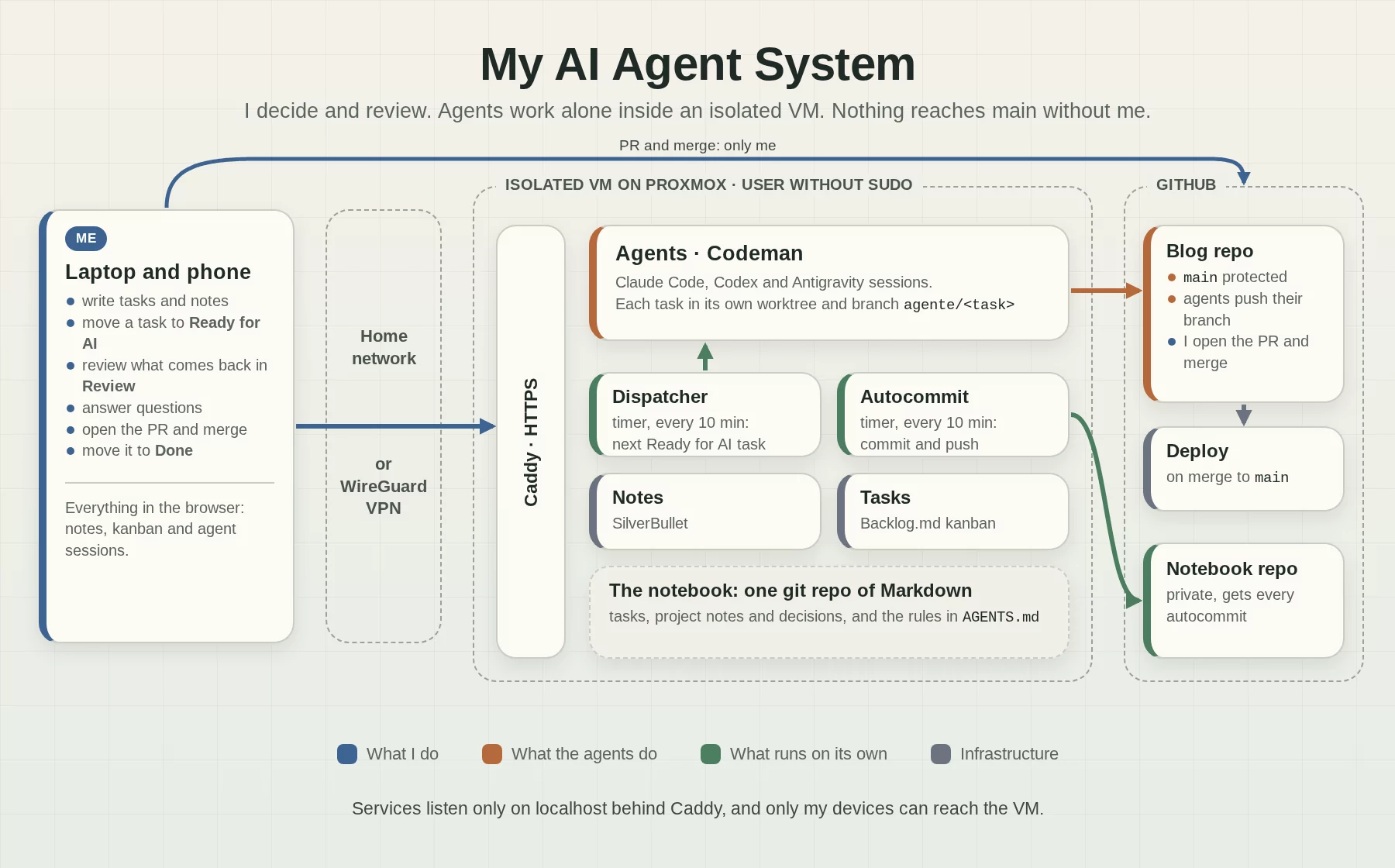
- An isolated VM on my Proxmox server at home. The agents run there with a user without sudo, and I reach it only from home or through WireGuard
- Codeman, which runs the agent sessions and lets me open them from any browser, also from the phone. I use three agents with it: Claude Code, Codex and Antigravity.
- The notebook, one git repository of Markdown files. I read and write my notes in it with SilverBullet, and the tasks live in the same repository, managed with Backlog.md and its kanban.
- The rules, one
AGENTS.mdfile that all the agents read: which tasks they can take, where they can write, how they must finish and what they can never touch. - The dispatcher, a systemd timer that every 10 minutes takes the next task from Ready for AI and opens an agent session for it
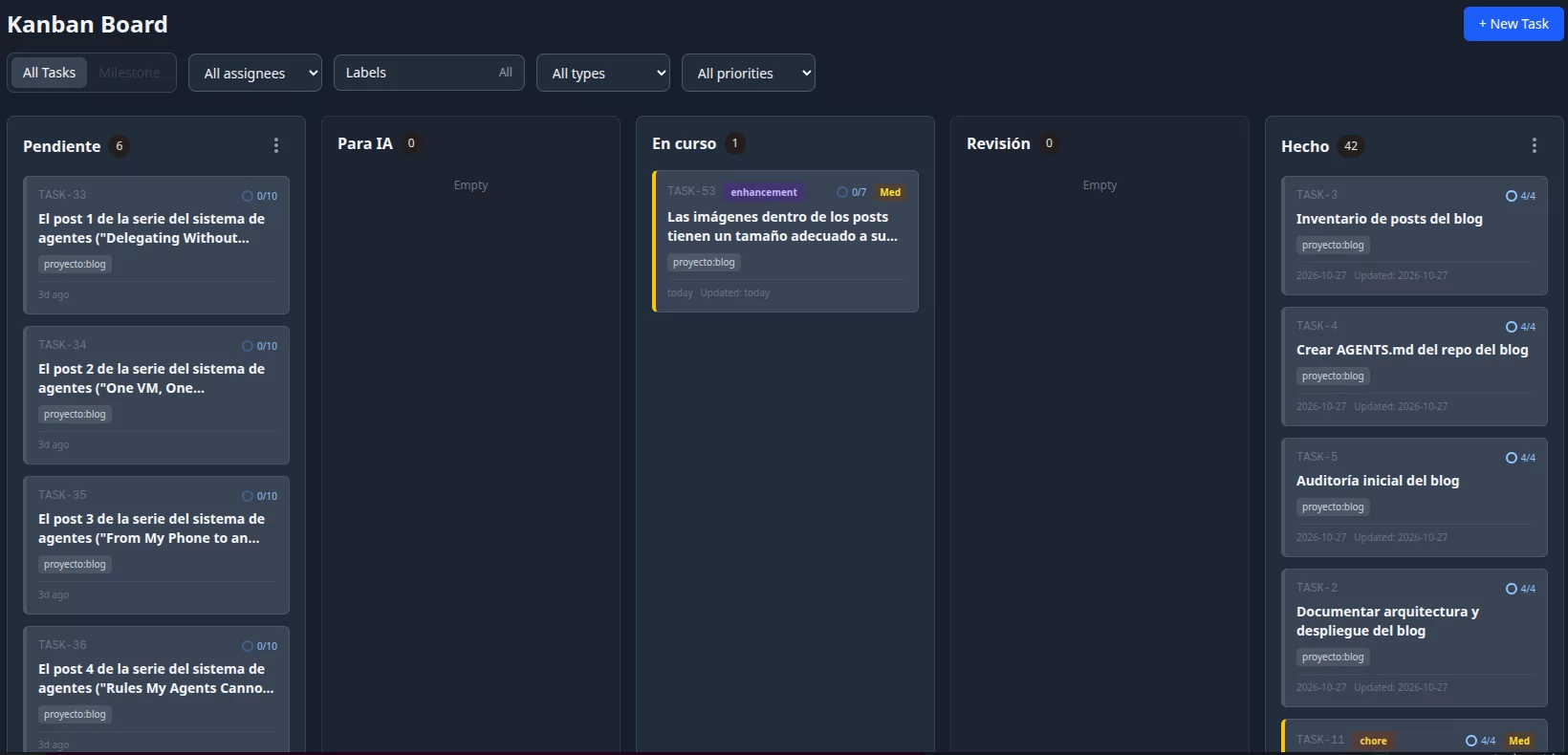
The notebook is in spanish, so the screenshots in this series are in Spanish too. The five columns of the kanban are Pendiente (Backlog), Para IA (Ready for AI), En curso (In progress), Revisión (Review) and Hecho (Done):
Who Does What
I create the tasks, I move them to Ready for AI, I review them and I move them to Done. If a task touches code, I open the pull request and I merge it. No agent does any of these things
The agent only works on what is in Ready for AI, and it always returns the task to Review. Finished, blocked or with a question, but never left in In progress. When something is not clear, the rule is not to guess: write the question in the task, add the label question (pregunta) and give it back to me. The dispatcher only gives the agent one fixed sentence: work on this task following AGENTS.md. Everything else is in the rules and the task.
This comes from something I wrote some months ago, in Spanish, about AI: no matter how good the tool is, you are still the last one responsible, and a person should be the one who presses the button and decides. Here that is not only an idea. The agents push to their own branch, main is protected, and the button to merge is mine.
It also follows what I learned studying physics with ChatGPT: the clearer and more structured the instructions, the better the result, and it helps a lot to ask it to show where things come from. So every task has a description, limits and acceptance criteria, and the agent has to prove each criterion in its result
Does It Work?
The first project in the system was this blog, and most of the changes you do not see were tasks done by agents. Some examples:
- The sitemap listed 129 URLs and 100 of them returned a 404. An agent fixed it, and another one checked that every Spanish post is in the Spanish sitemap.
- Broken links now show a proper 404 page instead of the generic one from the hosting
- Most pages had five
h1headings because of the contact block in the footer. Now there is one, and the language switcher is accessible. - Hugo went from 0.122.0 to a current version, and the build uses the official image.
- Internal links are relative now, so I can browse the preview of a pull request without being sent to production
Even this series started as a task: an agent proposed the index of posts from my notes, and I corrected it.
It is not perfect. Once an agent stopped and asked me because two of my own rules said opposite things, and it was right. The dispatcher only notices a stuck task if its session is closed, so an agent waiting forever with the session open blocks everything until I look. And for a while my documentation said that the dispatcher made a snapshot of the VM before each task, which it never did. Those stories go at the end of the series.
What This Series Is Not
This is not a product, and it is not a step by step guide to copy. I want to explain what each piece does and why I decided it, so you can take the ideas that fit your setup.
What comes next:
- One VM, one unprivileged user: where my AI agents live.
- The notebook, the kanban and the life of a task, from my phone to an agent
- The rules my agents cannot edit
- The dispatcher that hands tasks to my agents every ten minutes.
- What went wrong, and what I learned.
Conclusions
I did not build this because agents are perfect. I built it because they are good enough to work alone for a while, and I did not want to spend that while watching them.
The agents work. I decide. And honestly, that split is the part I like the most